
Halley Maza, Ph.D.
Director of Research & Learning Innovation
Center for Reaching & Teaching the Whole Child
 Over the past year, the Center for Reaching & Teaching the Whole Child has had the privilege of partnering with the Residency Lab at the Californians Dedicated to Education Foundation and an incredible community of educator preparation leaders from across California to explore one important question:
How can educator preparation programs prepare future educators to integrate artificial intelligence in ways that are thoughtful, equitable, and grounded in professional judgment?
This work has been an exciting opportunity to bring together complementary areas of expertise. Through a yearlong Community of Practice, educator preparation leaders representing 33 educator preparation programs engaged in collaborative inquiry, examined emerging research and policy guidance, shared implementation challenges and promising practices, and worked together to imagine what responsible, human-centered AI integration could look like across educator preparation.
For our Center, this partnership represented an opportunity to contribute an important perspective to the growing conversation around artificial intelligence.
While AI continues to transform teaching and learning, we believe it also reinforces the importance of the social, emotional, and cultural dimensions of education. The decisions educators make every day—how they build relationships, recognize and respond to bias, exercise professional judgment, navigate ethical questions, and create learning environments where every learner feels valued and supported—remain deeply human. As AI becomes increasingly integrated into educational systems, these competencies become even more essential.
The CRTWC Anchor Competencies Framework has always been grounded in the belief that preparing educators extends beyond developing technical knowledge. It involves cultivating the knowledge, competencies, and dispositions that enable educators to think critically, collaborate effectively, respond across differences, and make context-sensitive decisions that support the whole child. Throughout this Community of Practice, we found ourselves returning to these same ideas again and again. Responsible AI integration is not simply about understanding technology; it is about ensuring educators are prepared to use that technology with wisdom, care, equity, and purpose.
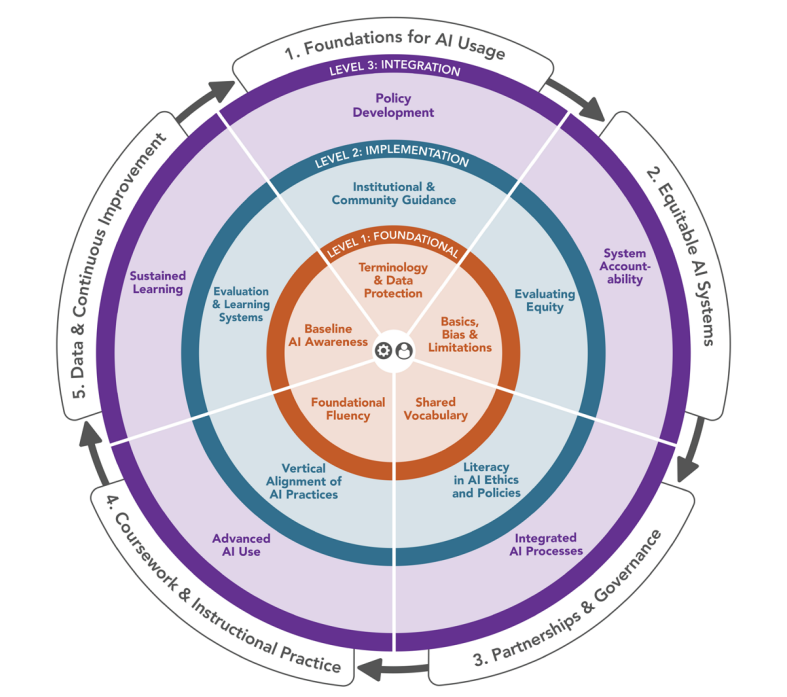
The AI Integration Continuum reflects the collective learning that emerged from this partnership. Co-developed through collaboration among the Residency Lab, the Center for Reaching & Teaching the Whole Child, and educator preparation leaders across California, the continuum offers a human-centered approach to AI integration that recognizes technology is only one part of the equation. Equally important are the educators, leaders, and preparation programs making intentional decisions about how AI can enhance teaching and learning while preserving the relationships, professional judgment, and whole-child perspective that define excellent education.
We are deeply appreciative of Dr. Kate Herman and the Residency Lab for their leadership and vision in convening this work, and of the educator preparation leaders who generously shared their expertise throughout the Community of Practice. We are also grateful for the leadership of our Executive Director, Dr. Rebecca Baelen, whose commitment to educator development and whole-child learning continues to shape the Center’s contribution to partnerships like this.
We hope this framework serves not only as a practical resource, but also as an invitation to continue the conversation. As AI continues to evolve, so too must our commitment to preparing educators who lead with professional judgment, cultivate meaningful relationships, and bring a strong social, emotional, and cultural lens to every decision they make. We believe those human capacities will remain at the heart of excellent teaching—and they are more important than ever in the age of AI.
We also recognize that a framework alone is not enough. Meaningful change happens through ongoing learning, reflection, and collaboration. In the months ahead, the Residency Lab and the Center for Reaching & Teaching the Whole Child will continue to build on this work through a series of webinars and professional learning opportunities designed to further explore the ideas presented in this framework. Together, we’ll take a deeper dive into each domain of the AI Integration Continuum, share emerging examples from the field, and continue learning alongside educator preparation leaders as we collectively navigate what thoughtful, equitable, and human-centered AI integration can look like in educator preparation and education systems.
We hope you’ll join us as we continue this conversation, learn from one another, and explore how we can prepare educators to embrace innovation while ensuring the social, emotional, and cultural dimensions of teaching and learning remain at the heart of our work. For more information on, join us for a Deep Dive Series with the Residency Lab, running September 2026 – May 2027. Learn more and register here.